The problem
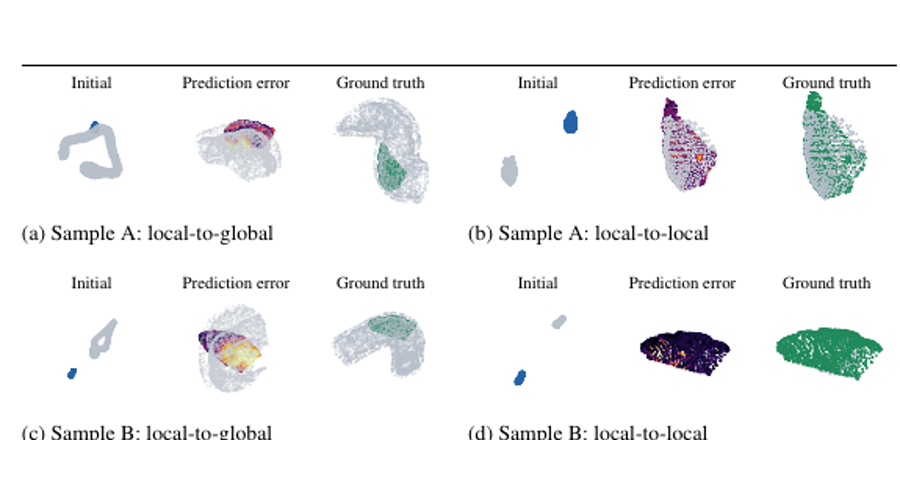
Anatomy-aware colonoscopic navigation needs to match partial endoscopic observations to a stable anatomical reference. Repetitive haustral folds, similar tubular geometry, partial views, and noisy depth make this markedly different from standard rigid point-cloud registration datasets.
What I did
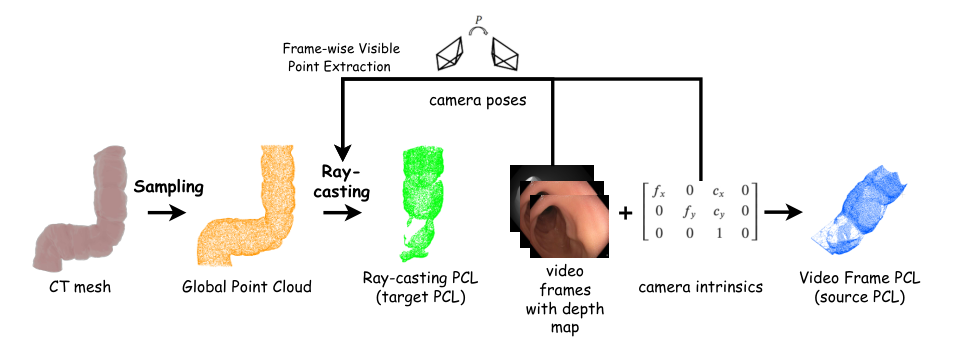
C3VDReg builds matched partial-to-partial point-cloud pairs from the public Colonoscopy 3D Video Dataset (C3VD), captured with a rigid silicone colon phantom. Source clouds come from released depth-map reprojection; target clouds come from raycasting the reference mesh at matched camera poses. Both clouds use a common protocol: 8,192 points, source-only perturbations, and a fixed pose convention.
Results and interpretation
- 10,015 matched pairs, including 2,088 held-out test pairs across six held-out sequences.
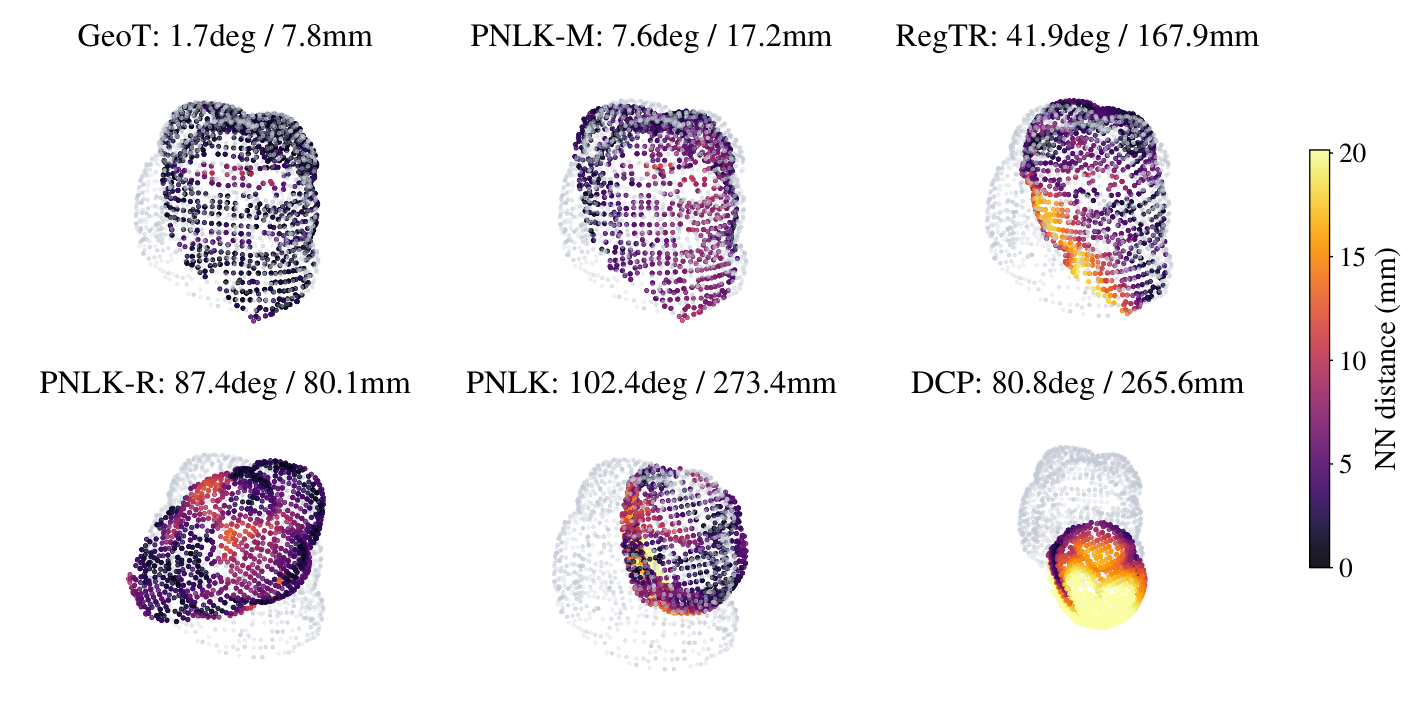
- The benchmark evaluates public baselines under one shared protocol.
- Despite 74.3–93.1% ground-truth overlap, registration recall is low across evaluated methods. Error decomposition suggests translation ambiguity along repetitive tubular anatomy as a major failure mode; an initialization-strength ablation remains important to separate ambiguity from starting-pose difficulty.
Limitations and clinical context
The underlying C3VD data were captured on a rigid phantom, not on deforming tissue in live patients. The reported 0.321 mm and 0.159° pose validation errors in the source dataset were measured in simulation rather than on real phantom video. This is a research benchmark; the measured registration results should not be interpreted as clinical navigation accuracy.
Citation
@article{jiang2025c3vdreg,
  title={C3VDReg: A Benchmark for Local-to-Local Colonoscopic Registration toward Anatomical Localization},
  author={Jiang, Linzhe and Huang, Jiayuan and Bano, Sophia and Clarkson, Matthew J. and Mao, Zhehua and Hoque, Mobarak I.},
  journal={arXiv preprint arXiv:2511.00260}, year={2025}
}